
Section 4.1 Extreme Values of Functions
Definition 4.1.1. Global Extrema.
Let \(f\) be a function with domain \(D\) (an interval or union of intervals). Then \(f\) has an absolute maximum value on \(D\) at a point \(c\) if \(f(c) \geq f(x)\) for all \(x\) in \(D\text{.}\) And \(f\) has an absolute minimum value on \(D\) if \(f(x) \leq f(x)\) for all \(x\) in \(D\text{.}\)
Example 4.1.2.
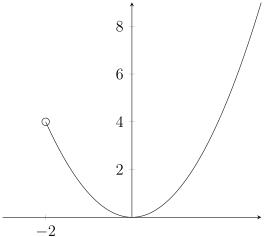
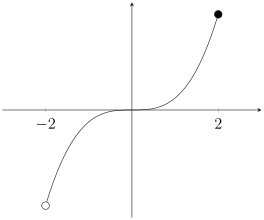
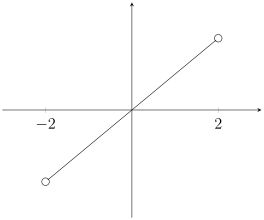
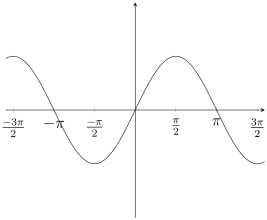
Find the absolute maxima and minima for the functions displayed below.
Fact 4.1.7. Extreme Value Theorem.
If \(f\) is continuous on a closed interval \([a,b]\text{,}\) then \(f\) has both absolute an absolute maximum and an absolute minimum in \([a,b]\text{.}\)
Note: There may be more than one absolute maximum and more than one absolute minimum.
Definition 4.1.8. Relative extrema.
A function \(f\) has a local maximum value at a point \(c\) in its domain \(D\) if \(f(c)\geq f(x)\) for all \(x\in D\) within some open interval around \(c\text{.}\)
A function \(f\) has a local minimum value at a point \(c\) in its domain \(D\) if \(f(c)\leq f(x)\) for all \(x\in D\) within some open interval around \(c\text{.}\)
Example 4.1.9.
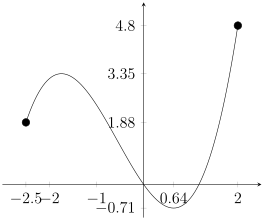
The function graphed below has:
A local minimum of \(1.88\) at \(x=-2.5\)
A local maximum of \(3.35\) at \(x=2\)
An absolute minimum of \(-0.71\) at \(x=0.64\)
An absolute maximum of \(4.8\) at \(x=2\)
Fact 4.1.11. First Derivative Theorem.
If \(f\) has a local extremum at \(x=c\text{,}\) an interior pont of its domain, and if \(f'\) is defined at \(c\text{,}\) then \(f'(c)=0\text{.}\)
Definition 4.1.12. Critical point.
An interior point \(c\) of the domain of \(f\) is a critical point if either:
\(f'(c)=0\text{,}\) or
\(f'\) is undefined at \(c\text{,}\) but \(f\) is defined at \(c\text{.}\)
Example 4.1.13.
Find the critical points of the function \(\displaystyle f(x) = \sqrt{-x^2+4}\text{.}\)
Find the critical points of the function \(\displaystyle g(x) = \frac{\ln x}{x}\text{.}\)
\(\displaystyle -2,0,2\)
\(\displaystyle e\)
Fact 4.1.14.
To find the absolute extrema of a continuous function \(f\) on a closed interval:
Find all critical points.
Evaluate \(f\) at the critical points and the endpoints of the interval.
The largest value is the absolute maximum and the smallest value is the absolute minimum.
Example 4.1.15.
Find the absolute extrema of \(f(x) = |x|\) on the interval \(-2 \leq x \leq 4\text{.}\)
Find the absolute extrema of \(g(x) = \frac{\ln x}{x}\) on the interval \([1,5]\text{.}\)
Find the absolute extrema of \(h(x) = \frac{1}{10}(x-1)^2(x+3)^3\) on the interval \([-4,1\frac{1}{2}]\text{.}\)
Find the absolute extrema of \(k(x) = 3 \cos^{-1}(x^2)\text{.}\)
abs min \((0,0)\text{;}\) abs max \((4,4)\)
-
\(g(1)=0\text{,}\) \(g(e) \approx 0.3679\text{,}\) \(g(5) \approx 0.3219\)
abs min \((1,0)\text{;}\) abs max \((e,\frac{1}{e}\)
-
\(h(-4)=-2.5\text{,}\) \(h(-3)=0\text{,}\) \(h(-3/5)\approx 3.5389\text{,}\) \(h(3/2)\approx 2.2781\)
abs min \((-4,-2.5)\text{;}\) abs max at \(x=-3/5\)
abs min \((1,0)\) and \((-1,0)\text{;}\) abs max \((-1,3\pi)\)
Note: results about extreme values can be written as either:
The absolute maximum value \(5\) occurs at \(x=2\text{;}\) or
The absolute maximum occurs at \((2,5)\text{.}\)