
Section 1.2 Combining Functions
This section focuses on arithmetic combination of functions and composition and the effect of these operations on domains and graphs.
Fact 1.2.1. Sum, Difference, and Products of Functions.
The domain of the sum, difference, or product of functions is the intersection of the domains; that is, the domain of the combined function is everything allowed in both functions.
Example 1.2.2.
The functions \(f(x)=\frac{1}{x}\) and \(g(x)=\sqrt{9-x^2}\) have domains \((-\infty,0)\cup (0,\infty)\) and \([-3,3]\text{,}\) respectively.
What are the domains of
\(\displaystyle (f+g)(x)=\frac{1}{x}+\sqrt{9-x^2}\)
\(\displaystyle (f-g)(x)=\frac{1}{x}-\sqrt{9-x^2}\)
\(\displaystyle (fg)(x)=\frac{1}{x}\sqrt{9-x^2}\)
\([-3,0)\cup (0,3]\)
Fact 1.2.3. Quotients of Functions.
The domain of the quotient of two functions is the intersection of the domains minus all values that make the denominator 0; that is, the domain is all numbers in the domains of both functions that do not make the denominator 0.
Example 1.2.4.
The functions \(f(x)=\frac{1}{x}\) and \(g(x)=\sqrt{9-x^2}\) have domains \((-\infty,0)\cup (0,\infty)\) and \([-3,3]\text{,}\) respectively.
What are the domains of
\(\displaystyle \left(\frac{f}{g}\right)(x) = \frac{1/x}{\sqrt{9-x^2}}\)
\(\displaystyle \left(\frac{g}{f}\right)(x) = \frac{\sqrt{9-x^2}}{1/x}\)
\(\displaystyle (-3,0)\cup(0,3)\)
\([-3,0)\cup(0,3]\) (note this is not the same as \([-3,3]\text{;}\) also note that this is not the same as the domain of the function \(x\sqrt{9-x^2}\))
Definition 1.2.5.
Given functions \(f\) and \(g\text{,}\) the composition \(f\circ g\) is defined by \((f\circ g)(x)=f(g(x))\text{.}\)
Example 1.2.6.
The functions \(f(x)=\frac{1}{x}\) and \(g(x)=\sqrt{9-x^2}\) have domains \((-\infty,0)\cup (0,\infty)\) and \([-3,3]\text{,}\) respectively.
Find the values of \((f \circ g)(2)\text{,}\) \((g \circ f)(2)\) and formulas for \(f\circ g\) and \(g \circ f\text{.}\)
\(\displaystyle (f \circ g)(2)=\frac{1}{\sqrt{5}}\)
\(\displaystyle (g \circ f)(2)=\sqrt{8\frac{3}{4}}=\frac{\sqrt{35}}{2}\)
\(\displaystyle (f \circ g)(x)=\frac{1}{\sqrt{9-x^2}}\)
\(\displaystyle (g \circ f)(x)=\sqrt{9-\left(\frac{1}{x}\right)^2}\)
Fact 1.2.7. Domain of a Composition.
To find the domain of a composition \(f \circ g\text{:}\)
Start with the domain of the inner function, \(g\)
Remove from the domain any \(x\)-values such that \(g(x)\) is not in the domain of the outer function \(f\)
Example 1.2.8.
The functions \(f(x)=\frac{1}{x}\) and \(g(x)=\sqrt{9-x^2}\) have domains \((-\infty,0)\cup (0,\infty)\) and \([-3,3]\text{,}\) respectively.
Find the domains of \(f\circ g\) and \(g \circ f\text{.}\)
domain of \(f \circ g\text{:}\) \((-3,3)\)
domain of \(g \circ f\text{:}\) \((-\infty,-1/3)\cup(1/3,\infty)\)
Example 1.2.9.
Let \(f(x)=\sqrt{x}\) and \(g(x)=x^2\text{.}\)
Find the domains of \(f\circ g\) and \(g \circ f\text{.}\)
Example 1.2.10.
Let \(f(x) = x+5\text{,}\) \(g(x)=x^2\text{,}\) \(h(x) = -3x\text{,}\) \(j(x) = \sqrt{x}\text{,}\) and \(k(x) = \ln x\text{.}\) Express each of the following as a composition of one or more of the previous functions.
\(\displaystyle y = \sqrt{x+5}\)
\(\displaystyle y = \ln(x) + 5\)
\(\displaystyle y = x^2+5\)
\(\displaystyle y = -3x-15\)
\(\displaystyle y = \sqrt{-3x}\)
\(\displaystyle y = \ln(x^2+5)\)
Subsection 1.2.1 Transformations
Definition 1.2.11.
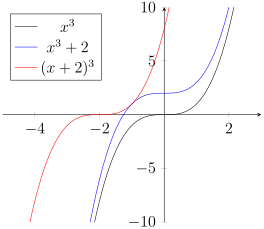
The graph of \(y=f(x)+k\) is a vertical shift of the graph of \(f\) by \(k\) units up.
The graph of \(y=f(x-h)\) is a horizontal shift of the graph of \(f\) by \(h\) units right.
Example 1.2.12.
Sketch the graphs of \(y=x^3\text{,}\) \(y=x^3+2\text{,}\) and \(y=(x+2)^3\text{.}\)
https://www.desmos.com/calculator/j6ktt6dszt
Definition 1.2.14.
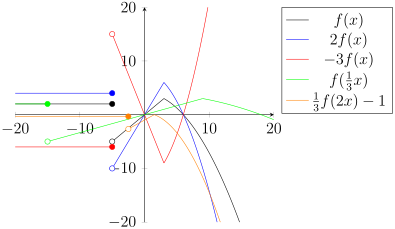
The graph of \(y=cf(x)\text{,}\) for \(c \gt 1\) is a vertical stretch of \(f\) by a factor of \(c\text{.}\)
The graph of \(y=cf(x)\text{,}\) for \(0 \lt c \lt 1\) is a vertical compression of \(f\) by a factor of \(c\text{.}\)
The graph of \(y=f(cx)\text{,}\) for \(c \gt 1\) is a horizontal compression of \(f\) by a factor of \(c\text{.}\)
The graph of \(y=f(cx)\text{,}\) for \(0 \lt c \lt 1\) is a horizontal stretch of \(f\) by a factor of \(c\text{.}\)
The graph of \(y=-f(x)\text{,}\) is a vertical reflection of \(f\text{.}\)
The graph of \(y=f(-x)\text{,}\) is a horizontal reflection of \(f\text{.}\)
Example 1.2.15.
For the function
sketch graphs of \(y=2f(x)\text{,}\) \(y=-3f(x)\text{,}\) \(y=f\left(\frac{1}{3}x\right)\text{,}\) and \(y=\frac{1}{3}f(2x)-1\text{.}\)
Example 1.2.17.
Given the function \(y=\sqrt{x}\text{,}\) find the equation for the function shifted 3 units right and 2 units down. Sketch graphs of both.
\(y=\sqrt{x-3}-2\)
Example 1.2.18.
Make up a (reasonably simple) piecewise graph \(y=f(x)\text{.}\) Trade with a neighbor and sketch \(y=f(3x)+2\) and \(y=-f(x+2)\text{.}\)
www.desmos.com/calculator/zamg65by0g