
Section 2.2 Limit of a Function and Limit Laws
Idea of limit: we don't care what \(f(2)\) is, we care about what \(f(x)\) does near \(x=2\text{.}\)
Example 2.2.1.
The function \(y=f(x)\) has graph:
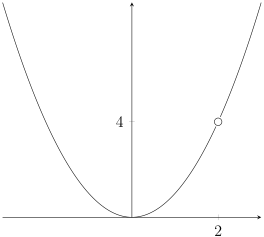
What is \(f(2)\text{?}\)
What is \(f(x)\) near \(x=2\text{?}\)
That function is defined by \(f(x)=\frac{x^3-2x^2}{x-2}\text{;}\) for \(x\neq 2\text{,}\) \(f(x)=x^2\text{.}\)
Definition 2.2.3. Limit, informally.
Let \(c\) be a real number and \(f\) a function defined on an interval around \(c\text{,}\) but possibly not at \(c\text{.}\) If there is a number \(L\) such that \(f(x)\) is arbitrarily close to \(L\) for all \(x\) sufficiently close to \(c\text{,}\) then we say that \(f\) approaches the limit \(L\) as \(x\) approaches \(c\text{,}\) written
The previous example illustrated that \(\lim_{x\rightarrow 2} \frac{x^3-2x^2}{x-2} = 4\text{.}\)
Example 2.2.4.
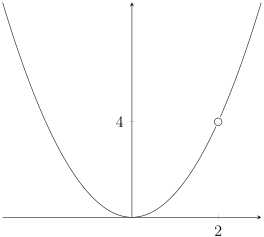
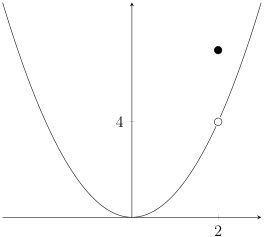
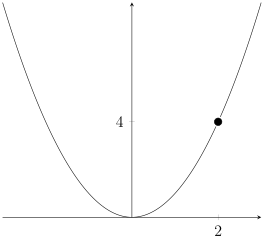
Note that \(f(2)\) is undefined, \(g(2)=7\) and \(h(2)=4\text{,}\) but
Limits need not exist:
Example 2.2.6.
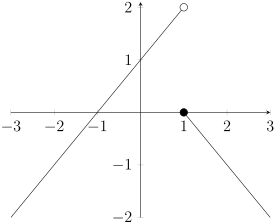
jump
\(f(x)=\begin{cases} x+1 \amp x\lt 1\\ -x+1 \amp x\geq 1\end{cases}\)
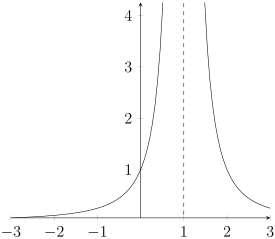
unbounded
\(g(x)=\frac{1}{(x-1)^2}\)
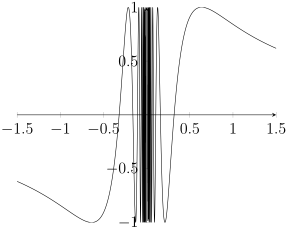
Oscillates
\(h(x)=\sin \frac{1}{x}\)
Two very basic functions and thier limits:
Fact 2.2.8.
For a constant function, \(f(x)=k\text{:}\) for any \(c\text{,}\) \(\lim_{x\rightarrow c} k = k\text{.}\)
For the identity function, \(f(x)=x\text{:}\) for any \(c\text{,}\) \(\lim_{x\rightarrow c} x = c\text{.}\)
Fact 2.2.9. Limit Laws.
Let \(f\) and \(g\) be functions, \(L\text{,}\) \(M\text{,}\) \(c\text{,}\) and \(k\) real numbers, and \(\displaystyle\lim_{x\rightarrow c} f(x)=L\) and \(\displaystyle\lim_{x\rightarrow c} g(x) = M\text{.}\) Then:
Sum Rule: \(\displaystyle\lim_{x\rightarrow c} [f(x)+g(x)] = L+M\)
Difference Rule: \(\displaystyle\lim_{x\rightarrow c} [f(x)-g(x)] = L-M\)
Constant Multiple Rule: \(\displaystyle\lim_{x\rightarrow c} [kf(x)] = kL\)
Product Rule: \(\displaystyle\lim_{x\rightarrow c} [f(x) g(x)] = LM\)
Quotient Rule: \(\displaystyle\lim_{x\rightarrow c} \left[\frac{f(x)}{g(x)} \right] = \frac{L}{M}\text{,}\) provided \(M \neq 0\)
Power Rule: \(\displaystyle\lim_{x\rightarrow c} \left(f(x)\right)^n = L^n\)
Root Rule: \(\displaystyle\lim_{x\rightarrow c} \sqrt[n]{f(x)} = \sqrt[n]{L}\) for \(n\) a positive integer and provided \(L\gt 0\) for even \(n\)
Example 2.2.10.
Suppose that \(\displaystyle\lim_{x\to -3} f(x) = 7\) and \(\displaystyle\lim_{x\to -3} g(x) = -2\text{.}\) Find the following limits:
\(\displaystyle \displaystyle\lim_{x\to -3} f(x) + 3g(x)\)
\(\displaystyle \displaystyle\lim_{x\to -3} \frac{f(x)}{(g(x))^2}\)
\(\displaystyle 1\)
\(\displaystyle 7/4\)
Example 2.2.11.
Use the limit laws to compute: \(\displaystyle\lim_{x\rightarrow 2} 3x^3-5x+1\text{.}\)
\(15\)
Example 2.2.12.
Use the limit laws to compute: \(\displaystyle\lim_{x\rightarrow 3} \sqrt{2x-1}\text{.}\)
\(\sqrt{5}\)
Fact 2.2.13.
These examples illustrate that: if \(f(x)\) is an algebraic function which is defined at \(c\text{,}\) then \(\displaystyle\lim_{x\rightarrow c} f(x) = f(c)\text{.}\)
If \(f(x)\) is not defined at \(c\text{,}\) then the limit may or may not exist.
Fact 2.2.14. What to do when \(f(c)\) does not exist.
When \(f(x)\) is undefined, the limit may or may not exist. Three useful techniques that can show it does exist:
Factor \(x-c\) out of both the numerator and denominator and cancel.
Rationalize the numerator or denominator and simplify, possibly factoring and cancelling.
Simplify complex fractions
Example 2.2.15.
Compute the following limits:
\(\displaystyle \displaystyle\lim_{x\rightarrow 2} \frac{x^4-16}{x^3-8}\)
\(\displaystyle \displaystyle\lim_{x\rightarrow 2} \frac{\sqrt{x^2+12}-4}{x-2}\)
\(\displaystyle \displaystyle\lim_{x\rightarrow 3} \frac{x^2-3x}{\sqrt{x+3}-\sqrt{2x}}\)
\(\displaystyle \displaystyle\lim_{x\rightarrow 2} \frac{\frac{1}{3-x}-\frac{1}{x-1}}{x-2}\)
\(\displaystyle \displaystyle\lim_{x\rightarrow 0} \frac{\frac{1}{3+x}-\frac{1}{3}}{x}\)
\(\displaystyle 8/3\)
\(\displaystyle 1/2\)
\(\displaystyle -6\sqrt{6}\)
\(\displaystyle 2\)
\(\displaystyle -1/9\)
Theorem 2.2.16. Sandwich Theorem.
Suppose \(g(x) \leq f(x) \leq h(x)\) for all \(x\) in some open interval containing \(c\text{,}\) except possibly at \(c\) itself. If
then
Example 2.2.17.
Evaluate the following limits:
\(\displaystyle \displaystyle\lim_{\theta\rightarrow 0} \sin\theta\)
\(\displaystyle \displaystyle\lim_{\theta\rightarrow 0} \cos\theta\)
\(\displaystyle \displaystyle\lim_{x\rightarrow 0} x \sin \frac{1}{x}\)
Since \(-|\theta| \lt \sin\theta \lt |\theta|\) and \(\displaystyle\lim_{\theta \rightarrow 0} |\theta| = 0\text{,}\) \(\displaystyle\lim_{\theta\rightarrow 0} \sin\theta = 0\text{.}\)
Since \(0 \lt 1-\cos\theta \lt |\theta|\) and \(\displaystyle\lim_{\theta \rightarrow 0} |\theta| = 0\text{,}\) \(\displaystyle\lim_{\theta\rightarrow 0} 1-\cos\theta = 0\text{,}\) and thus \(\displaystyle\lim_{\theta\rightarrow 0} \cos\theta = 1\text{.}\)
Since \(-1 \leq \sin \frac{1}{x} \leq 1\text{,}\) \(-|x| \leq x \sin \frac{1}{x} \leq |x|\text{,}\) and \(\displaystyle\lim_{x\rightarrow 0} |x| = 0\text{,}\) so \(\displaystyle\lim_{x\rightarrow 0} x \sin\frac{1}{x} = 0\text{.}\)