
Section 3.2 The Derivative as a Function
Definition 3.2.1.
The derivative of the function \(f\) with respect to \(x\) is the function \(f'\) whose value at \(x\) is
provided the limit exists.
Note that the domain of \(f'\) is the set of points where the limit does exist.
If \(f'\) exists at a value \(x_0\text{,}\) we say that \(f\) is differentiable at \(x_0\text{;}\) if \(f'\) exists at every point in the domain of \(f\text{,}\) then we say that \(f\) is differentiable.
An alternate definition: \(\displaystyle\lim_{x\rightarrow x_0} \frac{f(x)-f(x_0)}{x-x_0}\)
Note on language: differentiation is the process of finding the derivative; to differentiate is the verb for computing the derivative.
Example 3.2.2.
Find the derivatives of:
\(\displaystyle f(x)=\sqrt{x}\)
\(\displaystyle g(x)=x^2+5x-7\)
- \begin{align*} f'(x) \amp =\lim_{h\to 0} \frac{f(x+h)-f(x)}{h}\\ \amp = \lim_{h\to 0} \frac{\sqrt{x+h}-\sqrt{x}}{h}\\ \amp = \lim_{h\to 0} \frac{\sqrt{x+h}-\sqrt{x}}{h} \frac{\sqrt{x+h}+\sqrt{x}}{\sqrt{x+h}+\sqrt{x}}\\ \amp = \lim_{h\to 0} \frac{(x+h)-x}{h(\sqrt{x+h}+\sqrt{x})}\\ \amp = \lim_{h\to 0} \frac{h}{h(\sqrt{x+h}+\sqrt{x})}\\ \amp = \lim_{h\to 0} \frac{1}{\sqrt{x+h}+\sqrt{x}}\\ \amp = \frac{1}{\sqrt{x+0}+\sqrt{x}}\\ \amp = \frac{1}{2\sqrt{x}} \end{align*}
- \begin{align*} g'(x) \amp =\lim_{h\to 0} \frac{g(x+h)-g(x)}{h}\\ \amp = \lim_{h\to 0} \frac{((x+h)^2+5(x+h)-7) - (x^2+5x-7)}{h}\\ \amp = \lim_{h\to 0} \frac{(x^2+2xh +h^2+5x+5h-7) - (x^2+5x-7)}{h}\\ \amp = \lim_{h\to 0} \frac{2xh +h^2+5h}{h}\\ \amp = \lim_{h\to 0} \frac{h(2x +h+5)}{h}\\ \amp = \lim_{h\to 0} \frac{2x +h+5}{1}\\ \amp = 2x+0+5\\ \amp = 2x+5 \end{align*}
Some notation: Given \(y=f(x)\text{:}\)
For the value of the derivative at a specific point:
Example 3.2.3.
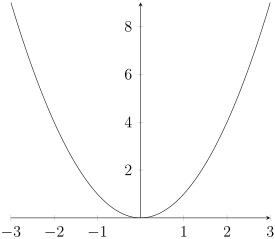
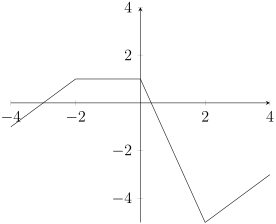
The graphs of \(y=f(x)\) and \(y=g(x)\) are shown. Sketch the graphs of the derivatives.
Definition 3.2.6.
\(f\) is differentiable on an open interval if the derivative exists at every point in the interval.
\(f\) is differentiable on a closed interval \([a,b]\) if it is differentiable on \((a,b)\) and if both
\(\displaystyle\lim_{h\rightarrow 0^+} \frac{f(a+h)-f(a)}{h}\) (right-hand derivative at \(a\)), and
\(\displaystyle\lim_{h\rightarrow 0^-} \frac{f(b+h)-f(b)}{h}\) (left-hand derivative at \(b\))
exist.
Note that the derivative exists at a point only if the left- and right-hand derivatives both exist and agree.
Example 3.2.7.
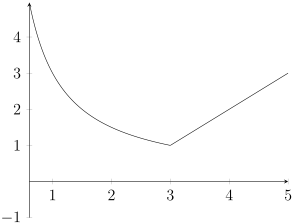
Let \(\displaystyle f(x) = \begin{cases} \frac{3}{x}\amp x\leq 3\\ x-2 \amp x \gt 3 \end{cases}\text{.}\) Is \(f\) differentiable at \(x=3\text{?}\)
Examples of how a function can be not differentiable.
- Corner
As in the example above.
- Vertical tangent
-
For example, \(y=\sqrt[3]{x}\)
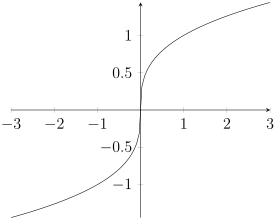
Figure 3.2.9. \(y=\sqrt[3]{x}\) - Cusp
-
The one-sided derivatives are \(\pm\infty\text{,}\) with opposite signs, e.g., \(\displaystyle f(x) = \sqrt{|x|} = \begin{cases} \sqrt{-x} \amp x \lt 0\\ \sqrt{x} \amp x \geq 0 \end{cases}\)
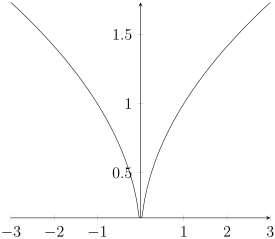
Figure 3.2.10. \(y=\sqrt{|x|}\) - Discontinuity
A function is non-differentiable at any point of discontinuity.
Theorem 3.2.11.
If \(f\) is differentiable at \(x=c\text{,}\) then \(f\) is continuous at \(x=c\text{.}\)
Note that the converse is false: a function can be continuous and not differentiable.