
Section 1.1 Functions and Their Graphs
This section of the book is a review of functions.
Subsection 1.1.1 Function Basics
Definition 1.1.1. Function.
A function \(f\) is a rule that assigns to every member \(x\) of a domain \(D\) a unique element \(f(x)\text{.}\)
Functions can be thought of as a “machine” or “black box” and can be represented/described in a variety of ways:
Verbal
Formula
Table
Graph
Example 1.1.2.
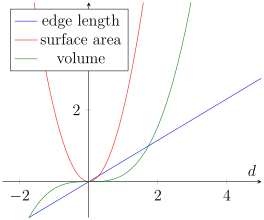
Express the edge length of a cube as a function of the cube's diagonal length d. Then express the surface area and volume of the cube as a function of the diagonal length, and graph the three functions.
edge length: \(\displaystyle e(d) = \frac{d}{\sqrt{3}}\)
surface area: \(\displaystyle S(d) = 2d^2\)
volume: \(\displaystyle V(d) = \frac{d^3}{3\sqrt{3}}\)
Pay attention to notation: \(y=f(x)\)
\(x\) and \(y\) are variables representing real numbers (elements of the domain and codomain).
\(f\) is a variable representing a function.
\(f(x)\) is the result of applying the function \(f\) to the number represented by \(x\text{.}\)
Writing \(f(x)=2x^3-5\) expresses the result of applying the function \(f\) to the number represented by \(x\text{.}\)
While writing \(y=2x^3-5\) expresses a relationship between the variables \(x\) and \(y\text{.}\)
Definition 1.1.4.
The domain of a function is the set of all possible input values. For a function defined by a formula, the (natural) domain is the largest set of real numbers for which the formula gives a real number result.
Example 1.1.5.
What is the (natural) domain of \(f(x)=130 - 5x\text{?}\)
A tank initially holding 130 cubic feet of water is emptied by a pump that pumps 5 cubic feet of water a minute. The volume of water in the take after \(t\) minutes of pumping is \(V(t)=130 - 5t\text{.}\) What is the domain of V?
\((-\infty,\infty)\)
\([0,26]\)
Example 1.1.6.
Write the following in interval notation.
\(\displaystyle x\geq 5\)
\(\displaystyle x \lt 3\)
\(\displaystyle -3 \leq x \lt 7\)
All real numbers neither between nor including \(-1\) and \(1\)
All real numbers other than \(4\)
\(\displaystyle [5,\infty)\)
\(\displaystyle (-\infty,3)\)
\(\displaystyle [-3,7)\)
\(\displaystyle (-\infty,-1) \cup (1,\infty)\)
\(\displaystyle (-\infty,4) \cup (4,\infty)\)
Definition 1.1.7.
A function's codomain is a set containing all possible output values. The range of a function is the set of all output values actually obtained by the function.
Example 1.1.8.
What is the range of \(S(d)=2d^2\text{?}\)
\([0,\infty)\)
For functions arising out of a specific context, the natural domain is not always realistic and a more restrictive domain may be more appropriate.
Example 1.1.9.
What is the range of \(f(x)=130 - 5x\) (on its natural domain)?
What is the range of \(V(t)=130 - 5t\text{,}\) restricted to the domain \([0,26]\text{?}\)
Theorem 1.1.10.
If \(f\) is a function, then any vertical line will intersect its graph in at most one point. If some vertical line intercepts a graph in more than one point, then it is not the graph of a function.
Subsection 1.1.2 Common Functions
See also the handout on common functions 1 .
Constant Functions.
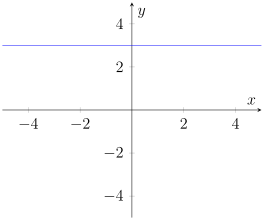
A constant function is a function defined by \(f(x)=c\text{,}\) where \(c\) is any real number (possibly 0).
- Formula
\(\displaystyle f(x)=c\)
- Domain
\(\displaystyle (-\infty,\infty)\)
- Range
\(\displaystyle \{c\}\)
- Graph
A horizontal line.
Linear Functions.
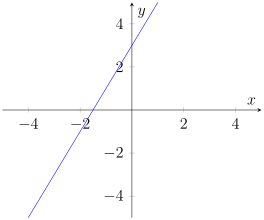
A linear function is a function of the form \(f(x)=mx+b\) where \(m\) and \(b\) are real numbers with \(m\neq 0\text{.}\)
- Formula
\(f(x)=mx+b\text{,}\) with \(m\neq 0\)
- Domain
\(\displaystyle (-\infty,\infty)\)
- Range
\(\displaystyle (-\infty,\infty)\)
- Graph
A line.
The identity function is the linear function with \(m=1\) and \(b=0\text{,}\) i.e., \(f(x)=x\text{.}\)
Power Functions.
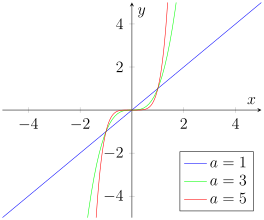
A power function is a function of the form \(f(x)=x^a\) for a constant \(a\text{.}\) The properties of the function varies significantly depending on the value of \(a\text{.}\)
\(a=1\).
The power function with exponent 1 is the identity function.
\(a\) a positive even integer.
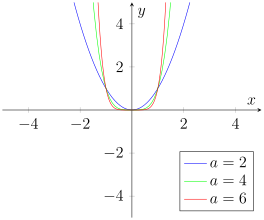
When \(a=2,4,6,\ldots\text{,}\) the graph of a power function is U-shaped.
- Formula
\(f(x)=x^a\text{,}\) with \(a=2,4,6,\ldots\)
- Domain
\(\displaystyle (-\infty,\infty)\)
- Range
\(\displaystyle [0,\infty)\)
- Graph
U-shaped
\(a\) a positive odd integer.
When \(a=1,3,5,\ldots\text{,}\) the graph of a power function is a bent line.
- Formula
\(f(x)=x^a\text{,}\) with \(a=1,3,5,\ldots\)
- Domain
\(\displaystyle (-\infty,\infty)\)
- Range
\(\displaystyle (-\infty,\infty)\)
- Graph
bent line
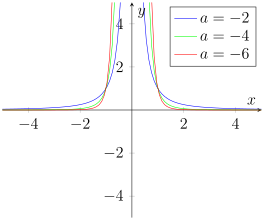
\(a\) a negative even integer.
When \(a=-2,-4,-6,\ldots\text{,}\) the graph of a power function is a volcano.
- Formula
\(f(x)=x^a\text{,}\) with \(a=-2,-4,-6,\ldots\)
- Domain
\(\displaystyle (-\infty,0)\cup(0,\infty)\)
- Range
\(\displaystyle (0,\infty)\)
- Graph
volcano
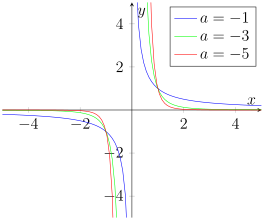
\(a\) a negative odd integer.
When \(a=-1,-3,-5,\ldots\text{,}\) the graph of a power function is not a volcano.
- Formula
\(f(x)=x^a\text{,}\) with \(a=-1,-3,-5,\ldots\)
- Domain
\(\displaystyle (-\infty,0)\cup(0,\infty)\)
- Range
\(\displaystyle (-\infty,0)\cup(0,\infty)\)
- Graph
?
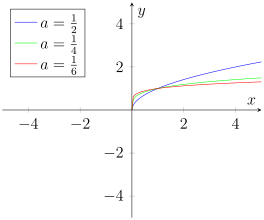
Even root.
When \(a=\frac{1}{2},\frac{1}{4},\frac{1}{6},\ldots\text{.}\)
- Formula
\(f(x)=x^a\text{,}\) with \(a=\frac{1}{2},\frac{1}{4},\frac{1}{6},\ldots\)
- Domain
\(\displaystyle [0,\infty)\)
- Range
\(\displaystyle [0,\infty)\)
- Graph
?
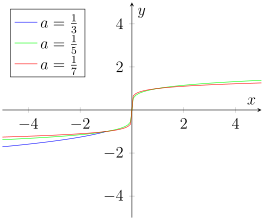
Odd root.
When \(a=\frac{1}{3},\frac{1}{5},\frac{1}{7},\ldots\text{.}\)
- Formula
\(f(x)=x^a\text{,}\) with \(a=\frac{1}{3},\frac{1}{5},\frac{1}{7},\ldots\)
- Domain
\(\displaystyle (-\infty,\infty)\)
- Range
\(\displaystyle (-\infty,\infty)\)
- Graph
?
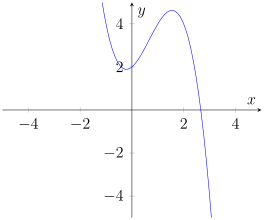
Polynomial Functions.
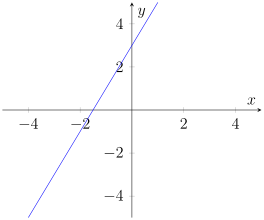
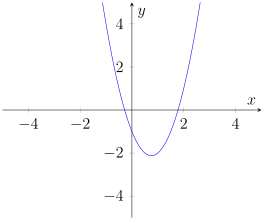
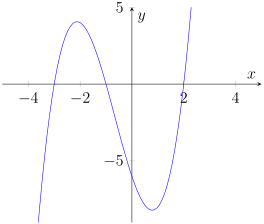
A polynomial function is a function of the form \(f(x)=a_n x^n + a_{n-1} x^{n-1} + \cdots + a_1 x + a_0\text{,}\) with \(n\) a positive integer and \(a_n\neq 0\text{.}\) The degree of the polynomial is the positive integer \(n\text{.}\)
- Formula
\(\displaystyle f(x)=a_n x^n + a_{n-1} x^{n-1} + \cdots + a_1 x + a_0\)
- Domain
\(\displaystyle (-\infty,\infty)\)
- Range
\(\displaystyle Varies\)
- Graph
Rational Functions.
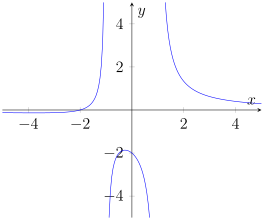
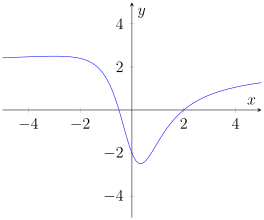
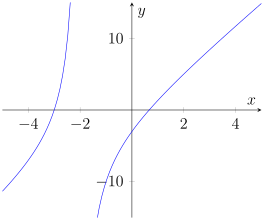
A rational function is the ratio of two polynomials; that is, it is of the form \(f(x) = \frac{p(x)}{q(x)}\) where \(p\) and \(q\) are both polynomials.
- Formula
\(\displaystyle f(x) = \frac{p(x)}{q(x)}\)
- Domain
\(\displaystyle q(x)\neq 0\)
- Range
\(\displaystyle Varies\)
- Graph
Definition 1.1.23. Algebraic function.
A function is algebraic if its formula involves only addition, subtraction, multiplication, division, and radicals.
Sine and Cosine.
- Formula
\(f(x) = \sin(x)\text{,}\) \(f(x)=\cos(x)\)
- Domain
\(\displaystyle (-\infty,\infty)\)
- Range
\(\displaystyle [-1,1]\)
- Graph
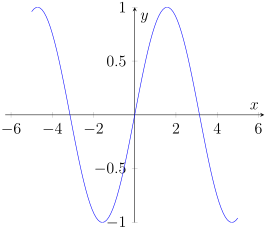
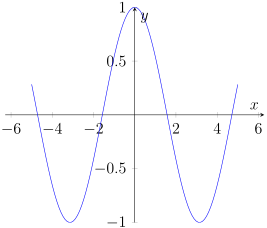
Exponential Functions.
An exponential function is a constant raised to a variable power; that is, it is of the form \(f(x) = a^x\) where \(a\) is a real number such that \(a\gt 0\) and \(a\neq 1\text{.}\)
- Formula
\(f(x) = a^x\) for \(a\gt 0\) and \(a\neq 1\)
- Domain
\(\displaystyle (-\infty,\infty)\)
- Range
\(\displaystyle (0,\infty)\)
- Graph
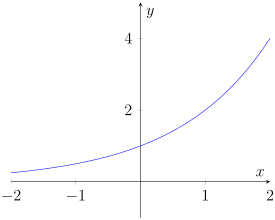
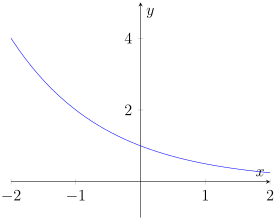
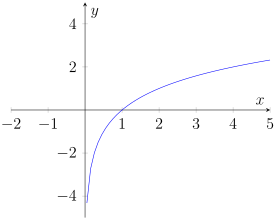
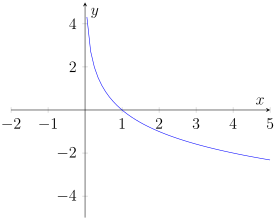
Logarithmic Functions.
A logarithmic function is the inverse of the exponential. It is of the form \(f(x) = \log_a(x)\) where \(a\) is a real number such that \(a\gt 0\) and \(a\neq 1\text{.}\)
- Formula
\(f(x) = \log_a(x)\) for \(a\gt 0\) and \(a\neq 1\)
- Domain
\(\displaystyle (0,\infty)\)
- Range
\(\displaystyle (-\infty,\infty)\)
- Graph
Definition 1.1.27. Transcendental function.
A function is transcendental if it is not algebraic. Transcendental functions include the trigonometric, exponential, and logarithmic functions, among others.
Piecewise-Defined Functions.
A piecewise-defined function is a function that is defined by different formulas over separate intervals.
Example 1.1.28.
For the function
calculate \(f(-7), f(-5), f(-1), f(3), f(5)\) and sketch a graph.
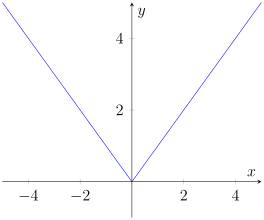
Absolute Value Function.
The absolute value function is the function that takes every real number and returns its absolute value. It can be defined as
- Formula
\(\displaystyle f(x)=|x|\)
- Domain
\(\displaystyle (-\infty,\infty)\)
- Range
\(\displaystyle [0,\infty)\)
- Graph
V
Subsection 1.1.3
Definition 1.1.30. Increasing/Decreasing.
A function \(f\) is said to be increasing on an interval \(I\) if the graph rises from left to right throughout that interval; i.e., if \(f(x_2)\gt f(x_1)\) whenever \(x_2\gt x_1\) are in \(I\text{.}\)
A function \(f\) is said to be decreasing on an interval \(I\) if the graph falls from left to right throughout that interval; i.e., if \(f(x_2)\lt f(x_1)\) whenever \(x_2\gt x_1\) are in \(I\text{.}\)
Note 1.1.31.
The interval on which a function is increasing or decreasing should (for MyMathLab's sake) always be open, e.g., we would say that \(y=x^2\) increases on \((0,\infty)\text{.}\)
Example 1.1.32.
Over what intervals are the standard functions above increasing and decreasing?
Definition 1.1.33. Even/Odd Function.
A function \(f\) is even if \(f(-x)=f(x)\text{;}\) that is, if it is symmetric about the \(y\)-axis.
A function \(f\) is odd if \(f(-x)=-f(x)\text{;}\) that is, if it is symmetric about the origin.
Example 1.1.34.
Which of the standard functions described earlier are even, which are odd, and which are neither?
even functions include: constant functions, power functions of even (positive or negative) degree, \(\cos\text{,}\) absolute value
odd functions include: the identity function, power functions of odd (positive or negative) degree, \(n\)th root for odd \(n\text{,}\) \(\sin\)
Subsection 1.1.4 More on domain
Fact 1.1.35. Finding Domain.
Given a formula for a function, to find it's domain, consider the types of basic functions that make it up. The function's domain must obey the restrictions placed on it by the fundamental functions.
In particular, denominators must not be 0, the arguments under even radicals must not be negative, and arguments of logarithms must be positive.
Example 1.1.36.
Find the domains and ranges of:\(\displaystyle f(x)=\frac{5}{x+2}\)
\(\displaystyle g(x)=\sqrt{x-7}\)
\(\displaystyle h(x)=\sqrt{9-x^2}\)
\(\displaystyle (-\infty,-2)\cup (-2,\infty)\)
\(\displaystyle [7,\infty)\)
\(\displaystyle [-3,3]\)
calc1.leavesofmath.com/handouts/commonFunctions.pdf