
Section 1.3 Trigonometric Functions
Definition 1.3.1.
The unit circle is the circle centered at the origin of radius 1. Its equation is \(x^2+y^2=1\text{.}\) With an angle in standard position, the measure of an angle in radians is the length of the corresponding arc.
Note that for a circle of radius \(r\text{,}\) the length of an arc corresponding to an angle \(\theta\) is \(r\theta\text{.}\)
| \(2\pi\) | full circle |
| \(\pi\) | half circle |
| \(\frac{\pi}{2}\) | quarter circle/right angle |
| \(\frac{\pi}{3}\) | bigger than \(\frac{\pi}{4}\text{,}\) \(60^{\circ}\) |
| \(\frac{\pi}{4}\) | half a right angle, \(45^{\circ}\) |
| \(\frac{\pi}{6}\) | smaller than \(\frac{\pi}{4}\text{,}\) \(30^{\circ}\) |
Angles larger than \(2\pi\) wrap around the circle, e.g., \(\frac{17\pi}{6}\) is equivalent to \(\frac{5\pi}{6}\text{.}\)
Negative angles are positioned clockwise.
Two points of view of sine and cosine:
Right triangles
Unit circle
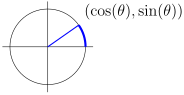
Based on the unit circle, we immediately know the values for \(\theta=0,\frac{\pi}{2},\pi,\frac{3\pi}{2}\text{.}\)
The unit circle also makes the signs of sine and cosine clear for each of the four quadrants.
| \(\frac{\pi}{6}\) | \(\frac{\pi}{4}\) | \(\frac{\pi}{3}\) | |
| \(\sin\) | \(\frac{1}{2}\) | \(\frac{\sqrt{2}}{2}\) | \(\frac{\sqrt{3}}{2}\) |
| \(\cos\) | \(\frac{\sqrt{3}}{2}\) | \(\frac{\sqrt{2}}{2}\) | \(\frac{1}{2}\) |
| \(\tan=\frac{\sin}{\cos}\) | \(\frac{1}{\sqrt{3}}\) | \(1\) | \(\sqrt{3}\) |
Note 1.3.5.
MyMathLab may sometimes require rational denominators, e.g., \(\frac{\sqrt{3}}{3}\) instead of \(\frac{1}{\sqrt{3}}\) and \(\sqrt{2}\) rather than \(\frac{2}{\sqrt{2}}\text{.}\)
| \(\sin\theta\) | \(\csc\theta=\frac{1}{\sin\theta}\) |
| \(\cos\theta\) | \(\sec\theta=\frac{1}{\cos\theta}\) |
| \(\tan\theta=\frac{\sin\theta}{\cos\theta}\) | \(\cot\theta=\frac{1}{\tan\theta}=\frac{\cos\theta}{\sin\theta}\) |
Example 1.3.7.
Compute the following:
\(\displaystyle \sin\left(\frac{5\pi}{3}\right)\)
\(\displaystyle \sec\left(\frac{-3\pi}{4}\right)\)
\(\displaystyle \cot 3\pi\)
If you know that \(\tan\theta = \frac{-5}{6}\) and that \(\theta \in \left[\frac{\pi}{2},\pi\right]\text{,}\) then what are \(\sin\theta\) and \(\cos\theta\text{?}\)
If you know that \(\cos\theta = \frac{2}{5}\) and that \(\theta \in \left[-\pi,-2\pi\right]\text{,}\) then what are \(\sin\theta\) and \(\tan\theta\text{?}\)
\(\displaystyle \frac{-\sqrt{3}}{2}\)
\(\displaystyle \frac{-2}{\sqrt{2}}=-\sqrt{2}\)
\(\displaystyle 0\)
\(\sin\theta = \frac{5}{\sqrt{61}}\text{;}\) \(\cos\theta = \frac{-6}{\sqrt{61}}\)
\(\sin\theta = -\frac{\sqrt{21}}{5}\text{;}\) \(\tan\theta = -\frac{\sqrt{21}}{2}\)
Definition 1.3.8. Periodic function.
A function \(f\) is periodic if there is a positive number \(p\) such that \(f(x+p)=f(x)\) for all \(x\text{.}\) The smallest such \(p\) is called the period.
Fact 1.3.9.
\(\sin,\cos,\sec,\csc\) all have period \(2\pi\text{.}\)
\(\tan\) and \(\cot\) both have period \(\pi\text{.}\)
Example 1.3.10.
Which of the trig functions are even and which are odd?
\(\cos\) and \(\sec\) are even, while the others are all odd.
Definition 1.3.11. Sinusoid.
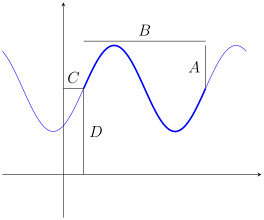
The sinusoid or general sine function is given by the formula
where
\(|A|\) is the amplitude
\(|B|\) is the period
\(C\) is the horizontal shift
\(D\) is the vertical shift
Example 1.3.13.
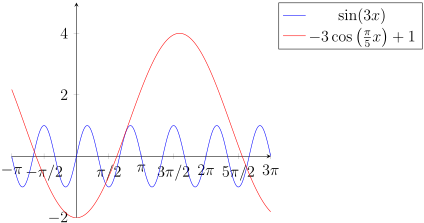
Find the period and graph
\(\displaystyle y=\sin(3x)\)
\(\displaystyle y=-3\cos\left(\frac{\pi}{5} x\right) + 1\)
There are a variety of ways to approach finding the period. One of the more straightforward is to set the coefficient of the variable equal to \(\frac{2\pi}{B}\) and solve for \(B\text{.}\)
Solving \(3=\frac{2\pi}{B}\text{,}\) we get the period is \(\frac{3}{2\pi}\text{.}\)
Solving \(\frac{\pi}{5} = \frac{2\pi}{B}\text{,}\) the \(\pi\)s cancel and the period is \(\frac52\text{.}\)
Pythagorean Identities:
Addition Formulas:
Double-Angle Formulas
Half-Angle Formulas
Law of Cosines
Law of Sines
Useful inequalities
Example 1.3.15.
Compute the values of \(\sin \frac{7\pi}{12}\) and \(\cos \frac{\pi}{8}\text{.}\)