
Section 3.4 The Derivative as a Rate of Change
The instantaneous rate of change of \(f\) at \(x_0\) is \(f'(x_0)\text{.}\)
Definition 3.4.1. Linear motion.
An object moves in a straight line and its position \(s\) is given as a function of time \(t\text{:}\) \(s = f(t)\text{.}\)
The displacement over an interval \([t,t+\Delta t]\) is the change in position \(f(t+\Delta t)-f(t)\text{.}\)
Average velocity over the interval is
(Instantaneous) velocity at time \(t\) is
Speed at time \(t\) is \(|v(t)|\text{.}\)
Acceleration is the derivative of velocity or second derivative of position: \(a(t)=v'(t)=s''(t)\text{.}\)
Jerk is the derivative of acceleration: \(j(t) = a'(t) = v''(t) = s'''(t)\text{.}\)
Example 3.4.2.
An object is shot directly upwards; its height in feet at \(t\) seconds is given by \(s(t)=40t-16t^2\text{.}\)
How far does the object travel between time \(t=1\) and \(t=2\text{?}\)
What is its average velocity over that interval?
What is its velocity at 1 second?
What are the acceleration and jerk of the object at \(t=1\) seconds?
When does the object change direction?
How high does the object go?
When does it hit the ground?
Example 3.4.3.
The velocity of an object is described by the graph below:
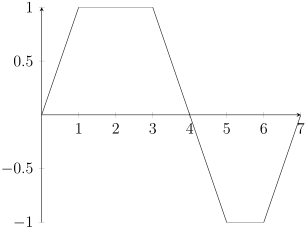
When does the object reverse direction?
When is it moving at constant speed?
Graph the object's speed.
Graph its acceleration.
Example 3.4.5.
The volume of a sphere is \(V=\frac{4}{3}\pi r^3\text{.}\) How fast does the volume change with respect to the radius when the radius is 3 inches?
\(\frac{dV}{dr} = 4\pi r^2\text{;}\) \(\left.\frac{dV}{dr}\right|_{r=3} = 36\pi \approx 113.1\text{;}\) that is, when the radius is 3 inches, the volume changes at a rate of \(113.1\) cubic inches per inch.
Example 3.4.6. Marginal cost of production.
If the cost in dollars of producing \(x\) widgets is \(c(x)=x^3-4x^2+12x+15\) for \(0 \leq x \leq 50\text{,}\) then the marginal cost of production is \(c'(x)\) and describes the additional cost of producing more units.
Example 3.4.7. Sensitivity to change.
A typical human body surface area \(S\text{,}\) in square meters, is modeled by
where \(h\) is the height in centimeters and \(w\) the weight in kilograms.
-
Recall that
\begin{equation*} 2.54 \times (\text{feet}\times 12 + \text{inches}) = \text{cm} \end{equation*}and
\begin{equation*} 0.453592 \times \text{pound}=\text{kg} \end{equation*} A particular person is 168 cm (5'6'') tall. Find \(S\) as a function of weight for this height.
The person weighs 61 kg (135 pounds); find \(S'(61)\text{.}\)
Is \(S\) more sensitive for higher or lower weights?
Marginal: term used in economics for change in response variable corresponding to change in independent variable.
Sensitivity to change: interpretation of derivative as a way to compare the impact of a change in the independent variable at different levels.