
Section 2.4 One-Sided Limits
Recall that one of the reasons a limit may not exist is a jump, e.g.,
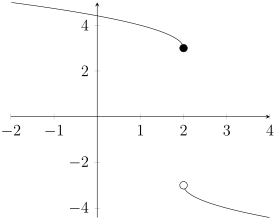
\(\displaystyle\lim_{x\rightarrow 2} f(x)\) does not exist because of the jump, but we can say:
The limit as \(x\) approaches 2 from the left is \(\displaystyle\lim_{x\rightarrow 2^-} f(x) = 3\text{.}\)
The limit as \(x\) approaches 2 from the right is \(\displaystyle\lim_{x\rightarrow 2^+} f(x) = -3\text{.}\)
Definition 2.4.2. One-sided limit.
If \(f\) is a function defined on an open interval \((a,c)\text{,}\) that is, \(f\) is defined to the left of a number \(c\text{,}\) then we say the limit of \(f(x)\) as \(x\) approaches \(c\) from the left is L and write \(\displaystyle\lim_{x\rightarrow c^-} f(x)=L\) if \(f(x)\) can be made arbitrarily close to \(L\) for all \(x\) sufficiently close to but less than \(c\text{.}\)
If \(f\) is a function defined on an open interval \((c,b)\text{,}\) that is, \(f\) is defined to the right of a number \(c\text{,}\) then we say the limit of \(f(x)\) as \(x\) approaches \(c\) from the right is L and write \(\displaystyle\lim_{x\rightarrow c^+} f(x)=L\) if \(f(x)\) can be made arbitrarily close to \(L\) for all \(x\) sufficiently close to but greater than \(c\text{.}\)
Note that for a piecewise-defined function, like the one above, we can calculate the one-sided limit by evaluating the function definition whose domain includes the appropriate side.
Fact 2.4.3.
For an interior point \(x=c\text{,}\) i.e., a point for which the function is defined on both sides, the two-sided limit, \(\displaystyle\lim_{x\rightarrow c} f(x)\) exists and equals \(L\) if and only if both \(\displaystyle\lim_{x\rightarrow c^-} f(x)=L\) and \(\displaystyle\lim_{x\rightarrow c^+} f(x)=L\text{.}\)
For a boundary point, the two-sided limit exists provided the appropriate one-sided limit exists.
Example 2.4.4.
Find the given limits using the graph.
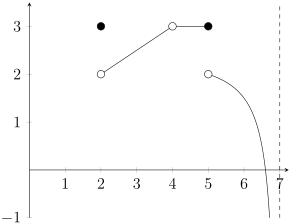
\(\displaystyle \displaystyle\lim_{x\rightarrow 4^-} f(x), \lim_{x\rightarrow 4^+} f(x), \lim_{x\rightarrow 4} f(x)\)
\(\displaystyle \displaystyle\lim_{x\rightarrow 5^-} f(x), \lim_{x\rightarrow 5^+} f(x), \lim_{x\rightarrow 5} f(x)\)
\(\displaystyle \displaystyle\lim_{x\rightarrow 7^-} f(x), \lim_{x\rightarrow 7^+} f(x), \lim_{x\rightarrow 7} f(x)\)
\(\displaystyle \displaystyle\lim_{x\rightarrow 2^-} f(x), \lim_{x\rightarrow 2^+} f(x), \lim_{x\rightarrow 2} f(x)\)
Note that \(\displaystyle\lim_{x\rightarrow \frac{\pi}{2}^-} \tan x\) and \(\displaystyle\lim_{x\rightarrow 0^+} \sin \frac{1}{x}\) still don't exist.
Example 2.4.6.
Find \(\displaystyle\lim_{x\rightarrow 0^-} \sqrt{x}\text{,}\) \(\displaystyle\lim_{x\rightarrow 0^+} \sqrt{x}\text{,}\) and \(\displaystyle\lim_{x\rightarrow 0} \sqrt{x}\text{.}\)
\(\displaystyle\lim_{x\rightarrow 0^-} \sqrt{x}\) does not exist, \(\displaystyle\lim_{x\rightarrow 0^+} \sqrt{x} = 0\text{,}\) and \(\displaystyle\lim_{x\rightarrow 0} \sqrt{x} = 0\text{.}\)
Example 2.4.7.
Find the limits:
\(\displaystyle \displaystyle\lim_{x\rightarrow -5^+} (x+7)\frac{|x+5|}{x+5}\)
\(\displaystyle \displaystyle\lim_{x\rightarrow -5^-} (x+7)\frac{|x+5|}{x+5}\)
-
When \(x\) approaches \(-5\) from the right, \(x \gt -5\) so \(x+5 \gt 0\text{,}\) so \(|x+5| = x+5\text{.}\) Thus,
\begin{equation*} \lim_{x\rightarrow -5^+} (x+7)\frac{|x+5|}{x+5} = \lim_{x\rightarrow -5^+} (x+7)\frac{x+5}{x+5} = \lim_{x\rightarrow -5^+} (x+7)\cdot 1 = 2 \end{equation*} -
When \(x\) approaches \(-5\) from the left, \(x \lt -5\) so \(x+5 \lt 0\text{,}\) so \(|x+5| = -(x+5)\text{.}\) Thus,
\begin{equation*} \lim_{x\rightarrow -5^+} (x+7)\frac{|x+5|}{x+5} = \lim_{x\rightarrow -5^+} (x+7)\frac{-(x+5)}{x+5} = \lim_{x\rightarrow -5^+} (x+7)\cdot (-1) = -2 \end{equation*}
Fact 2.4.8.
\(\displaystyle\lim_{\theta \rightarrow 0} \frac{\sin\theta}{\theta} = 1\)
Example 2.4.9.
Find the limit \(\displaystyle\lim_{t\rightarrow 0} \frac{\sin 5t}{3t}\)
\(\frac53\)