
Section 3.11 Linearization and Differentials
Subsection 3.11.1 Linearization
Definition 3.11.1. Linearization.
If \(f\) is differentiable at \(x=a\text{,}\) then the function
is the linearization of \(f\) at \(a\text{.}\) The approximation \(f(x) \approx L(x)\) of \(f\) by \(L\) is the standard linear approximation of \(f\) at \(a\text{.}\) The point \(x=a\) is called the center of the approximation.
Example 3.11.2.
Find the linearization of \(y=\sqrt[3]{x}\) at \(x=8\text{.}\)
\(L(x) = 2 + \frac{1}{12}(x-8)\)
Example 3.11.3.
Find the linearization of \(f(x)=\sin(x)\) that includes the point \(x_0=\frac{\pi}{7}\text{.}\) Center the linearization at a point \(x=a\) near \(\frac{\pi}{7}\) making the function easy to evaluate.
\(L(x) = \frac12 + \frac{\sqrt{3}}{2}\left(x-\frac{\pi}{6}\right)\)
Subsection 3.11.2 Differentials
Definition 3.11.4. Differential.
Let \(y=f(x)\) be a differentiable function. We use the special symbol \(dx\text{,}\) called a differential, as the independent variable and the differential \(dy\) as the dependent variable, to form the equation
\(dy = f'(x)\, dx\) expresses the infinitesimal change in y as a function of the change in x.
Example 3.11.5.
Let \(f(x)=x^2\text{.}\)
Find \(f'\)
Find the value of \(df=f'(x_0)\, dx\) when \(x_0=1\) and \(dx=0.1\text{.}\)
Estimate the value of \(f\) at \(x_0+dx\) as \(f(x_0)+df\text{.}\)
Find the actual change \(\Delta f = f(x_0+dx)-f(x_0)\text{.}\)
Find the error \(|\Delta f - df|\text{.}\)
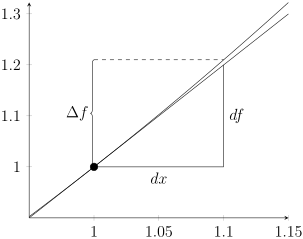
\(\displaystyle f'(x) = 2x\)
\(\displaystyle 0.2\)
\(\displaystyle 1.2\)
\(\displaystyle \Delta f = 1.21-1=0.21\)
\(\displaystyle |0.21-0.2|=0.01\)
Example 3.11.7. Estimating related change/sensitivity to change.
The diameter of a tree was 14 inches one year. The next year, the circumference increase 3 in.
Estimate the increase in diameter.
Estimate the increase in cross-sectional area.
Estimate the increase in cross-sectional area as a percentage of the previous area.
Example 3.11.8. Percent error.
A cylindrical storage tank is 10 meters tall. Its radius is \(3 \pm 0.25\) m. Estimate the percent error in calculating volume, \(V=\frac{1}{3}\pi r^2 h\text{.}\)
This calls for computing \(\frac{dV}{v}\) when \(r=3\) and \(dr=0.25\text{.}\)
Example 3.11.9.
The volume of a sphere must be calculated to within \(2\%\) of the true value. Find the greatest error that can be tolerated in the measurement of the radius, expressed as a percentage of \(r\text{.}\)